
What we ran.
The current studies use a transverse-field Ising starting model — TFIM-pure — as the circuit family. There is nothing exotic about that choice: TFIM is where you start when you want a clean baseline against which more interesting Hamiltonians will eventually get compared. The point of these initial runs is not to discover new physics inside TFIM. The point is to see what the engine does when pointed at a model whose behavior is already well-understood in the literature, and to verify that what comes out is meaningful before we move on.
Two pulse-program corners are studied: one configured to drive the system toward an ordered initial state, one configured to leave it disordered. The engine then evolves the lattice forward under a post-circuit coupling parameter that I will refer to as k* for the rest of these notes. The current sweep covers eight k* values from low coupling through mid-range coupling, with multiple evolution steps recorded out to step 200 and multiple independent runs at each setting. The extended time horizon is deliberate: earlier sweeps confined to step 50 turned out to be capturing intermediate states rather than terminal behavior, and one of the points of this note is to walk that back honestly.
Three order-parameter axes are tracked across the sweep: a z-down fraction (loosely, how much of the lattice has flipped against the initial alignment), an ordering strength (a measure of how organized the surviving structure is), and the absolute magnetization magnitude. Together they give a reasonable picture of what the system is doing without requiring any single metric to carry the full interpretation.
What the data shows.
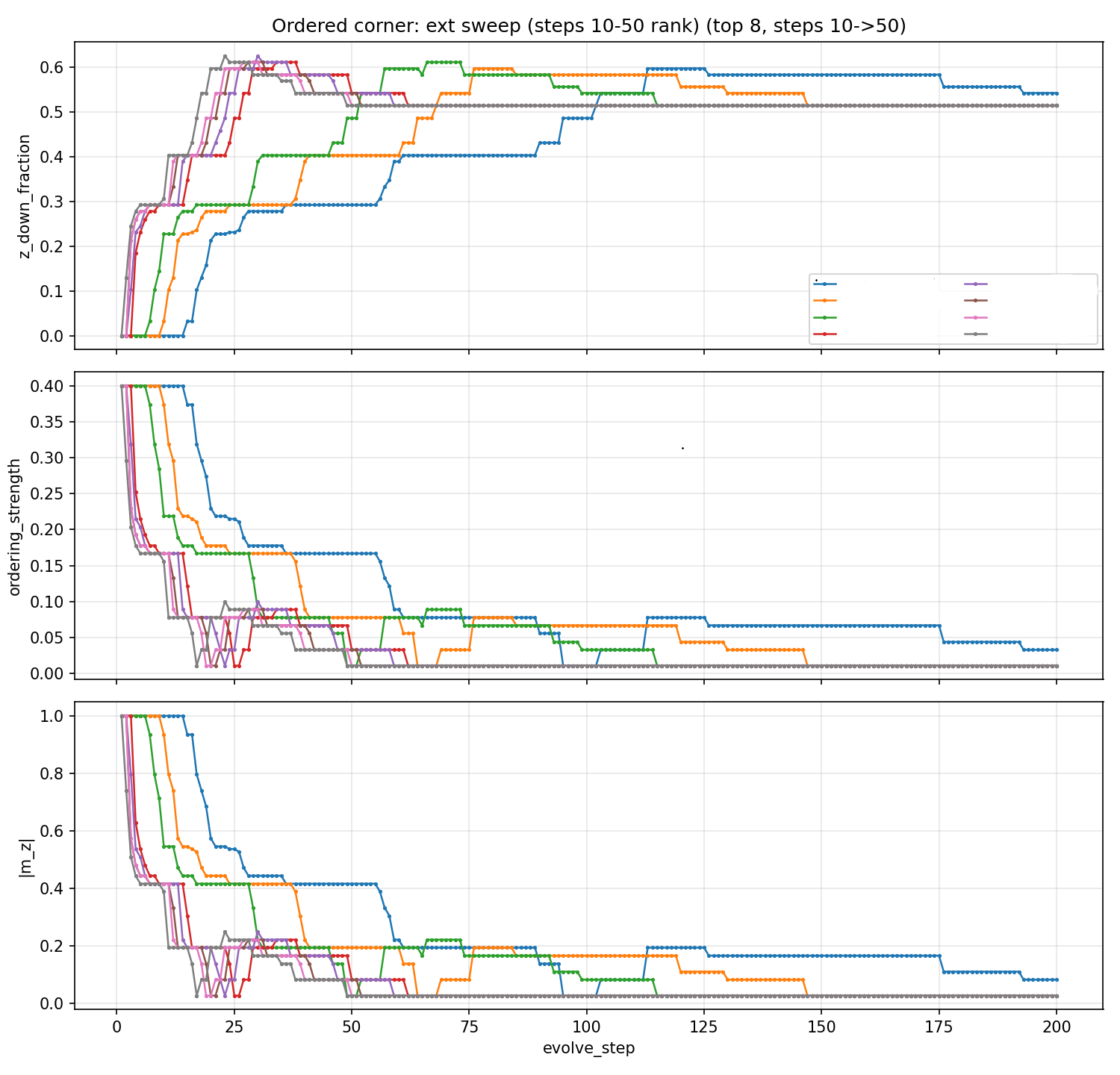
The ordered corner produces a cleaner story at the extended horizon than it did at the shorter one. After the circuit, the lattice sits at saturated z-alignment. As post-circuit evolution proceeds, the alignment melts at a rate that depends strongly on k*. Low k* produces gradual melt that continues to develop well past step 100. Mid-range k* settles into its terminal behavior earlier. High k* reaches its terminal regime within tens of steps and stays essentially flat for the rest of the evolution window.
k* is an internal control parameter of the SaC architecture that governs the evolution strength of the lattice.
Across the sweep, the terminal states are close to each other without being identical. Low-k* runs settle into a configuration with roughly 55% z-down and a small residual ordering strength. High-k* runs settle slightly lower in z-down and closer to zero in ordering. The destinations are similar in shape but distinguishable across the k* range — close enough that a coarser sweep or a shorter time window would read them as one shared basin, distinct enough that the extended-horizon data resolves them as a family of nearby end states.
The disordered corner produces a different story, and a more cautious one. From the start, the lattice is already mixed: ordering strength is low at step one and stays low through most of the sweep. What is interesting is what happens at higher k*, where late-time evolution shows directional evidence of ordering building up rather than decaying. That is not the behavior one would expect from a coupling parameter naively, and it is the kind of result that wants confirmation before we lean on it.
Claims, with their support levels stated.
The framing I am about to use will be familiar to anyone who has been forced to disambiguate observations from inferences in their own work. Each claim gets a support level. Claims that are quantitatively calibrated against repeat runs say so. Claims that are directionally supported but not yet quantitatively pinned down say so. Claims about regimes where the engine returns diagnostic warnings are flagged accordingly. The reader can read each claim at the support level it earns.
Claim 1. Post-pulse coupling (k*) controls how fast ordered alignment melts under post-circuit lattice evolution.
Supported. The relationship between k* and melt rate is consistent across the current sweep and across independent runs at each k* value. The cascade of melt onsets — low k* slow, high k* fast — is visible directly in the order-parameter trajectories and reproduces.
Claim 2. Late-time evolution from the ordered starting condition produces a family of similar but distinguishable terminal states across the k* range we examined.
Supported, with a correction to an earlier reading. An earlier 50-step sweep produced what looked like a shared late-time basin across a substantial fraction of the k* range. Extended to 200 steps, the trajectories continue to evolve past where the short sweep ended, and the terminal states resolve as a family of nearby end points rather than a single shared destination. The qualitative finding survives; the quantitative claim about a shared basin does not. We are reporting the corrected reading here rather than letting the earlier framing stand.
Claim 3. At sufficiently high k*, the ordered starting condition reaches its terminal regime quickly and stays there.
Supported. Order parameters for the higher-k* runs stabilize within tens of evolution steps and show no meaningful drift through the rest of the evolution window. This is a useful finding for budgeting evolution steps in future runs at the high-k* end of the range.
Claim 4. A disordered starting condition can gain ordering at high k* over post-circuit evolution.
Directionally yes. The observation appears in our data and is in the direction I have described. It is not yet quantitatively calibrated, and the engine returns numeric warnings in the regime where the strongest version of the effect appears. Additional runs and a careful look at the warning conditions are required before any quantitative version of this claim is publishable. I include it here because it is the kind of result that wants attention even in its pre-confirmation state.
A control-phase structure, with disclaimers.
Taken together, the results above sketch what I would call a control-phase diagram in the joint space of (pulse-program corner, k*, evolution time). Different regions of that space show qualitatively different behavior: fast melt, late-time shared basin, frozen plateau, possible ordering gain on the disordered side. The transitions between these regions appear at reproducible parameter values across independent runs.
The disclaimer is in the word “control.” k* is an engine parameter, not a measurable material constant. The coordinates of this diagram are not physical-temperature and physical-field axes that a magnet experimentalist would directly set. They are the parameters of the engine's post-circuit evolution, which is a deliberate design choice and not a stand-in for any specific real-world system. Calling this a phase diagram in the (β, γ, k*, t) space is honest. Calling it a phase diagram in physical (T, H, t) space would not be.
With that disclaimer in place: the structure is real, it reproduces, and it is the kind of structure that one would expect a richer Hamiltonian to inherit and elaborate on. The initial TFIM-pure runs are the baseline. Whatever comes next is going to be compared against it.
On the engine warnings.
Where I have flagged warnings, I am referring specifically to diagnostic outputs the engine produces about its own internal-energy estimates in certain regimes — mostly on the disordered side at extended evolution. These warnings are visible to us, recorded with the data, and have informed which claims I am willing to support quantitatively and which I am not.
The warnings do not invalidate the order-parameter observations. The bitstring-derived quantities and the spin-structure metrics are computed independently of the energy diagnostics and remain interpretable in the affected regimes. What the warnings do indicate is that the energy-based interpretations from those regimes need additional cross-checks before they earn a quantitative claim. That is the kind of thing we would rather you see than not see.
What comes next.
The extended-horizon sweep that produced these results refined two things at once: the terminal-state picture, which turns out to be a family of nearby end points rather than a single shared basin, and the budget question, which is now better-bounded for the high-k* end of the range. The methodological lesson — that intermediate plateaus can mimic terminal states under shorter time windows — is one I expect to apply across future studies, not just this one.
The next round of runs will refine the boundaries between the terminal-state family members, increase the statistical weight on the high-k* disordered observation, and extend coverage to additional pulse-program corners between the ordered and disordered cases. There is also a backlog of findings from elsewhere in our work that I expect to write up here as they clear review. The publishing rate from this repository should pick up.
A note on the methodology, since the question always comes up: these findings are produced by an engine that emerges microstates from the Hamiltonian rather than computing properties for configurations we specified. That methodological choice is what makes the engine able to surface this kind of structure at all. The runs do not require us to know in advance which configurations the system would reach. They tell us.
Engagement is on the main channel.
These working notes are for context. Formal discussions go through the main IQ Intel site.
Request a confidential discussion