
01
Compact circuit seed
Starts from a QASM template or a small related circuit family, not a manually enumerated circuit for every target state.
Proprietary computational datasets and models for material systems where conventional approaches are too slow, too shallow, or commercially inadequate.
IQ Intel produces proprietary datasets and models for problems where conventional approaches are too slow, too shallow, or commercially inadequate. We engage selectively where the value of non-public technical output is high and the use case is clear.
Gate-model quantum computing remains powerful for probabilistic computation. Subatomic Computing is built for deterministic, Hamiltonian-guided state exploration — discovering how structured physical systems move through state space.
IQ Intel starts with your material stack and the defects you care about. Together we derive the Hamiltonian, encode it in OpenQASM 2, and use our QASM extensions to evolve connected microstates. Post-processing stitches them into the full connected charge/discharge cycles we call seams, covering the full phase space the Hamiltonian defines.
Starts from a QASM template or a small related circuit family, not a manually enumerated circuit for every target state.
Evolves the encoded system through physical variants to reveal reachable microstates and transition structure.
Connects microstates into charge / discharge cycles, binding pathways, phase transitions, and movie-style visualizations.
IQ Intel is strongest where the objective is molecular and materials behavior: discovering how structured physical systems move through deterministic, Hamiltonian-governed state space.
A single material across its operating range moves through qualitatively distinct regimes. The SaC architecture surfaces that structure directly — not as inference from macroscopic measurement, but as the connected microstate evolution the system actually traverses.
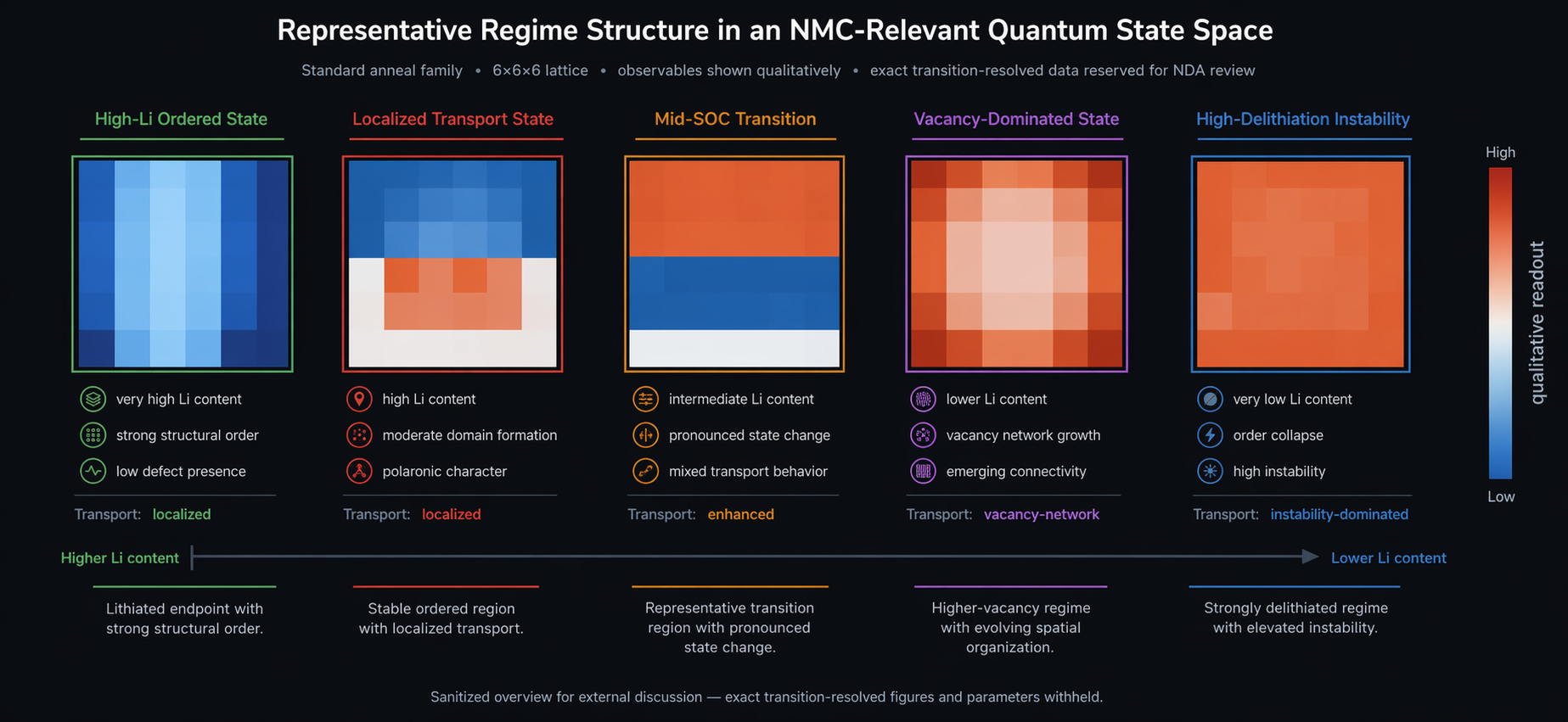
Sanitized overview from current battery-track work. Observables shown qualitatively; transition-resolved data reserved for client engagements.
Each microstate along a trajectory is resolved against 19 measures — the quantities we report for every state, grouped by what they describe about the system.
Per-site Z-basis occupation across the lattice; full spatial resolution.
Per-site transverse-X projection; full spatial resolution.
Per-site transverse-Y projection; full spatial resolution.
Per-site density field.
Mean longitudinal magnetization across the lattice.
Antiferromagnetic order parameter; signed sublattice difference.
Scalar measure of antiferromagnetic-order quality; complementary to the signed staggered magnetization.
Mean X and Y spin components.
√(⟨σx⟩² + ⟨σy⟩² + ⟨σz⟩²).
Scalar mean and per-site spatial map of the phase field.
Absolute mean of the phase field; robust to phase-symmetry cancellations that average the signed mean to zero.
Radial correlation function ⟨σizσjz⟩c by site separation.
Decay length of the two-point correlator above, in lattice sites.
⟨n²⟩ − ⟨n⟩². Compressibility proxy and fluctuation amplitude.
Computed from the three Pauli-basis bitstrings. Higher values indicate domain-like ordering and less mixed readout.
Carrier-localization length, reported in lattice sites and nm.
Connected-cluster occupation fraction.
Expectation value of the modeled Hamiltonian.
Application-calibrated site-occupancy estimate (e.g. Li fraction on cathode tracks), derived from the Z-basis bitstring and cross-checked against the phase field.
Conventional methods report a handful of observables at equilibrium, or one trajectory at a time. NMC811-IQ reports up to 19 measures per microstate, across connected trajectories.
These benchmarks measure what conventional quantum benchmarks do not: the trajectory structure of real material systems across their operating ranges. Two SOC ranges, 10-25% & 60-75%, are freely accessible — data and plots open for inspection. Full datasets follow engagement.
Connected microstate trajectories across the NMC811-IQ operating range, with 19 measures resolved per quantum microstate. Two complete seams open for public inspection; transition-resolved data behind engagement.
Open benchmark →Coupling-parameter sweep across the magnetic lattice, including corner-physics regimes surfaced by Hamiltonian-guided exploration. Working notes track methodology and findings in series.
Open benchmark →Open a sector to read how Subatomic Computing applies, or contact us about that sector directly.
Battery materials, charge-state behavior, regime mapping, and performance-window analysis.
Materials behavior, performance-region analysis, and structured datasets for design and optimization decisions.
High-value computational outputs for molecule, materials, and process questions where non-public data materially matters.
Property landscape exploration, regime identification, and structured dataset generation for R&D decisions.
Restricted, high-value technical engagements where confidentiality and decision advantage matter.
Specialized training and evaluation datasets where ground truth is otherwise costly, slow, or unavailable.
Two series. Signals tracks the battery track and broader methodology. Working Notes tracks magnetic-state evolution as it unfolds.
Findings, methodology, and what Subatomic Computing reveals when turned loose on real material systems.
Methodology and findings from the magnet track, posted as work proceeds.
Public detail is intentionally limited. If your organization has a defined technical objective and the ability to act on proprietary outputs, use the form.
U.S.-based industrial, strategic, or research organizations.
Limited by design. Method-level discussion generally follows fit review.
Selective. Sector relevance, seriousness, and a concrete use case matter.