
The standard workflow in computational materials science starts with a configuration. A unit cell. A defect supercell. A specific arrangement of atoms whose properties you want to know. The user supplies the configuration; the method computes the properties.
Density functional theory works this way. Most quantum chemistry works this way. Molecular dynamics works this way once the force field is chosen. The space of things the method can show you is bounded by the space of configurations you thought to specify.
This is enumeration. The user is responsible for the catalog of candidate states. The method is responsible for evaluating them. The output is a table indexed by what was asked.
There is nothing wrong with enumeration. Most of the materials science literature is built on it, and it is the right methodology for many questions. The point of this post is not that enumeration is broken. It is that emergence is a different methodology, and the difference shapes what the instrument can discover.
Emergence asks a different question.
The user supplies a circuit seed and a coordinate range. Not a catalog of states to evaluate. A seed: the Hamiltonian structure encoded in a compact OpenQASM template, plus the parameters that will be swept to vary the evolution. The engine then runs that structure forward and lets the microstates surface from the physics rather than from the user's enumeration.
What comes out is not a table indexed by what was asked. It is a set of microstates the system actually reaches. Some of them are configurations a researcher would have thought to specify. Some of them are not. The engine does not know the difference and does not need to. Whatever the Hamiltonian admits, the engine finds.
The methodological inversion is small to state and large in consequence. Enumeration asks: of the configurations I have listed, which has the lowest energy, the right band gap, the expected magnetic structure. Emergence asks: across the coordinate range I care about, what microstates does this Hamiltonian actually produce.
What the two methods see.
An enumerated study returns answers about configurations the user specified. If the user did not specify a configuration, the study cannot say anything about it. The space outside the catalog is silent.
An emergent study returns answers about configurations the physics produces. Whether the user knew to ask about them or not. The configurations the user would have specified are almost always in there. The ones they would not have specified are also in there, and those are where the surprises live.
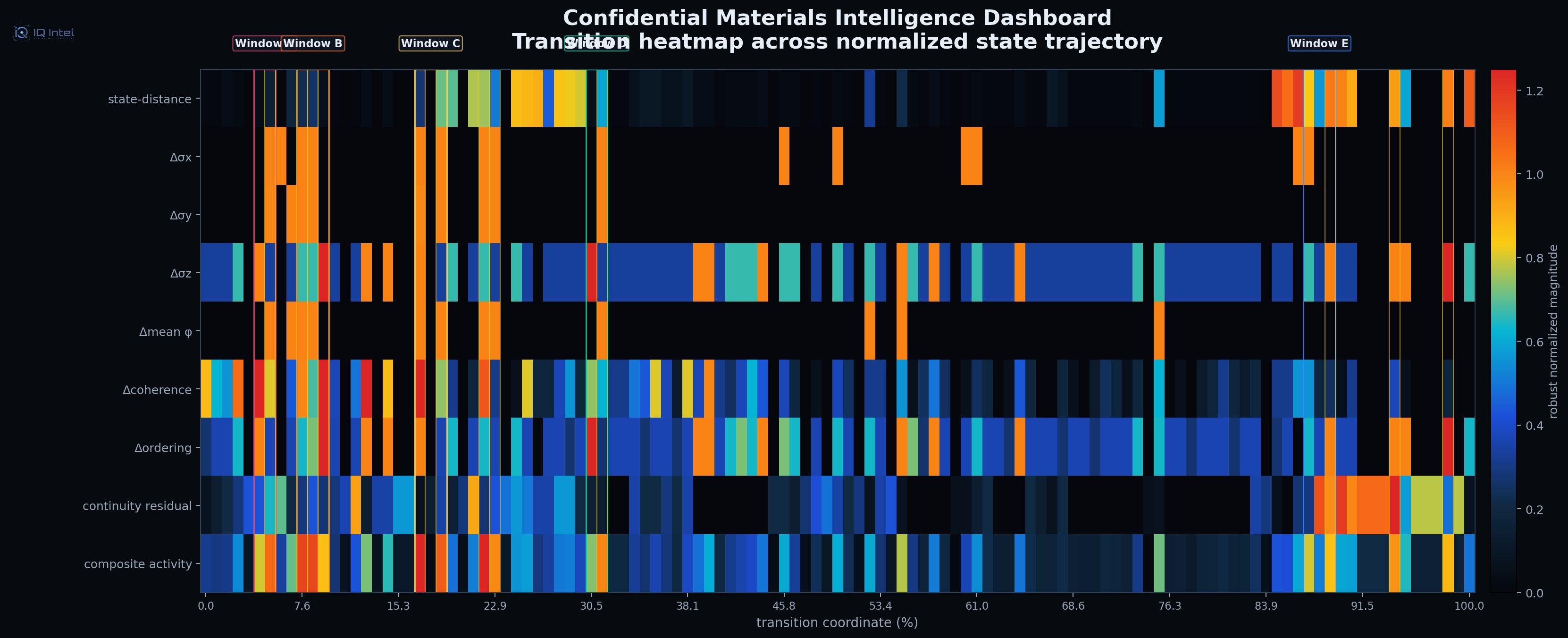
A concrete way to frame the distinction: imagine asking the two methods to characterize the state space of a material across its operating range. The enumerated method produces a list of points you defined. The emergent method produces the connected manifold the Hamiltonian actually visits. The first answer is faithful to your question. The second answer is faithful to the physics.
For materials that are well-understood, where the relevant configurations are already in the literature, enumeration and emergence converge. The interesting case is the one where the field does not yet know which configurations matter. Emergence surfaces them; enumeration cannot.
Why it matters for cell-level questions.
Battery cells, in operation, are not at the configurations a researcher would enumerate. They are at whatever configurations the physics drives them to, given the defect profile, the operating history, the local environment of each lattice site. The path the cell takes through its operating range visits states that no canonical study has catalogued, because the canonical studies were not asking that question.
An enumerated study can tell you the properties of the states it modeled. An emergent study can tell you which states the cell is in. If the goal is to predict how the cell will behave, the second answer is the one that determines the outcome.
The argument generalizes. The magnet team has been running an emergent study of their own on a TFIM-pure starting model, sweeping an engine coupling parameter and watching what emerges. From what they have shared, the sweep produced a reproducible window where the ordered program melts fastest under post-circuit evolution while the disordered program shows opposite behavior at higher coupling. A control-phase structure in their own parameter space, surfaced not from an enumerated catalog of configurations but from the physics running forward. Different material system, same methodological move. Their forthcoming release through benchmarks.iqintel.io will document the result on their terms.
Wherever the question is “what does the system actually do,” emergence is the methodology that answers it.
What emergence costs.
Emergent studies are harder to run than enumerated ones. The user does not get to constrain the answer space in advance. Validation is harder because the output cannot be checked against a pre-known list. The post-processing must do real work to organize what the engine surfaces into something a researcher can read.
That cost is paid on our side. The customer specifies the material and the operating range; we manage the work of turning emergent microstates into validated trajectories the customer can review. The cost shows up in the engagement timeline and in the depth of the deliverable, not in the customer's workflow.
What the customer gets in exchange for that cost is access to states they would not have known to enumerate. The unknown unknowns become visible. That is the real value.
A different question, not a better tool.
Subatomic Computing is not a faster way to run DFT. It is not a drop-in replacement for ab-initio methods. It is a different instrument that answers a different question, and the methodological line between “what do these configurations do” and “what configurations does this system reach” is the line that defines what each instrument can discover.
The right tool for a question depends on the question. If the configurations you care about are already on your list, an enumerated method is appropriate and efficient. If the configurations that determine your outcomes are not on anyone's list yet, emergence is the methodology that surfaces them.
The next post in this series will take this distinction one layer deeper, into why connected state evolution — the trajectory structure that connects emerged microstates — answers questions that even an emergent study cannot answer without it.
That is the case emergence was built for.
The engagement runs the physics forward and surfaces the states your work depends on.
Request a confidential discussion