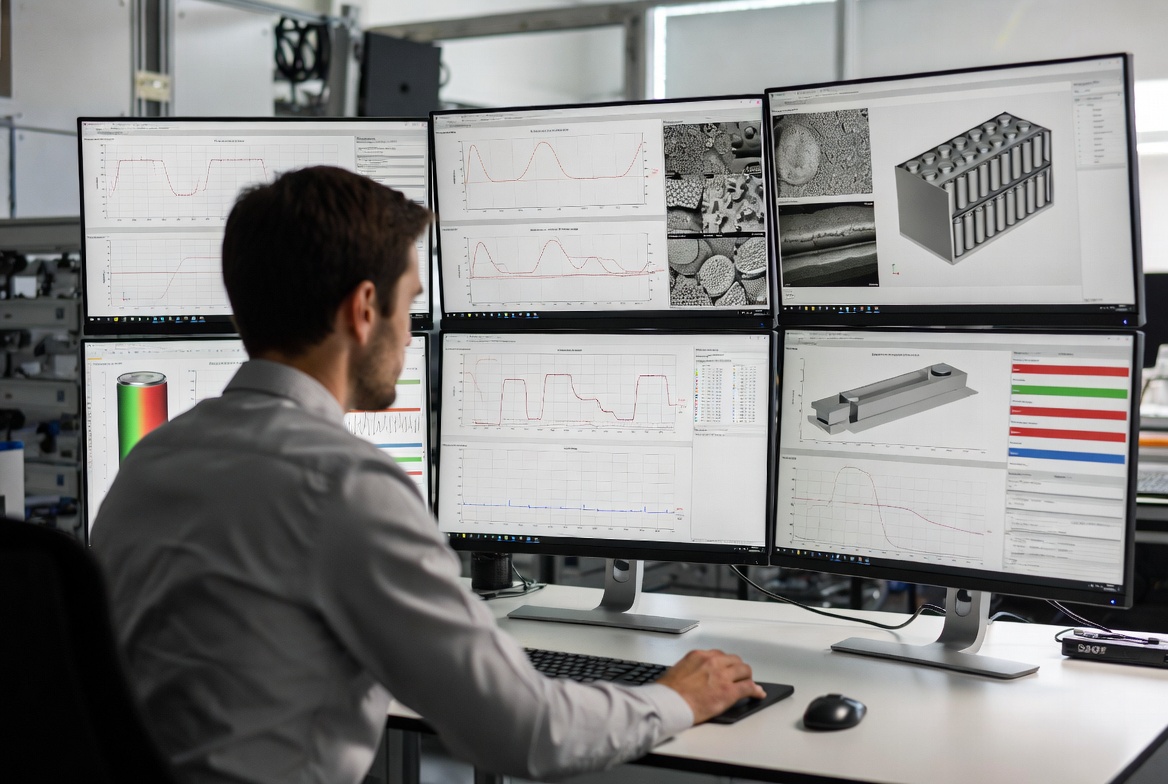
Connected microstate seams
Complete charge and discharge trajectories assembled from emerged microstates, validated frame by frame. Two to four cycles per defect configuration. The microstate JSON for every state, with audit hashes on each record.
Battery programs already have the characterization data. Subatomic Computing turns that data into the parameter set for a study that runs your cells' actual failure modes forward and shows what they do across the operating range.
An engagement produces a defined set of computational outputs structured for the people who will use them. Nothing here is a verdict on your cell. The outputs are the observable record. Your team decides what the findings mean for your roadmap.
Complete charge and discharge trajectories assembled from emerged microstates, validated frame by frame. Two to four cycles per defect configuration. The microstate JSON for every state, with audit hashes on each record.
Restricted desktop viewer with ten lattice rendering modes per microstate. Cycles play slowly enough that the human eye can absorb each state before the next. Phase diagrams across the engagement.
The qualitatively distinct regimes your material moves through across its operating range, surfaced directly from the trajectory data rather than inferred from macroscopic measurement. Sanitized previews available pre-engagement.
Most simulation work on battery defects uses canonical defect types — oxygen vacancy, transition-metal migration, surface reconstruction — modeled in idealized form. Useful but abstract. The cells you are shipping have specific defect profiles that emerge from your specific manufacturing process, your specific suppliers, your specific operating envelope.
Subatomic Computing parameterizes a study from your characterization data directly. A defect, encoded properly, is a perturbation on a circuit. Once the perturbation is in, the engine evolves the system and surfaces the microstates the configuration actually occupies. The same XRD, microscopy, impedance, and autopsy data your team has been collecting becomes the input to a forward-running study, not a label on a post-mortem.
What comes back is a connected, validated, frame-by-frame record of how your cell with your defects moves through state space. The kind of data you cannot collect on a real cell because the instrumentation does not exist, and you cannot compute on arbitrary defect configurations because no one else's engine handles emergence the way ours does.

The selective posture is easier to honor when the misconceptions are addressed up front. These are the things we are sometimes asked for and do not provide.
We do not tell you what your cells are doing wrong, what your next chemistry should be, or how to revise your design choices. The output is the observable record. Your team reads it.
Clients receive a complete dataset, not a single score or recommendation.The dataset includes connected microstate evolutions of your configuration. Interpretation belongs to your researchers, not to us.
We are not asking to co-author papers, share IP, share IP. This is delivery of proprietary computational outputs under defined terms. Production and delivery of all client datasets are air-gapped from end to end.
We engage selectively. The steps below describe what a serious inquiry moves through. Public detail is intentionally limited; method-level discussion follows fit review.